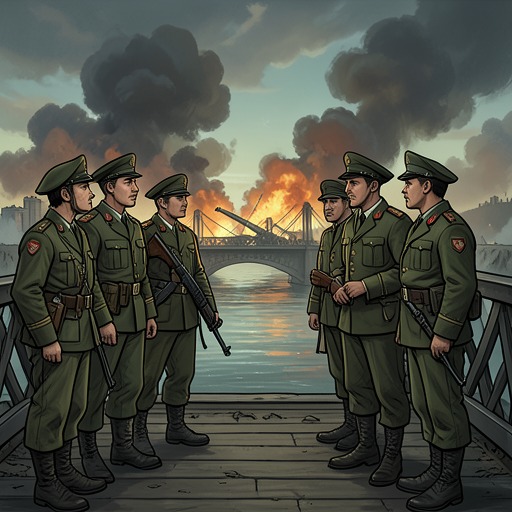
Robert Jordan and Maria
For Whom the Bell TollsRobert Jordan and Maria’s relationship becomes a concentrated experience of love under wartime limits: a bond discovered quickly, shared with tenderness, and valued all the more because neither can promise it a future. Its intimacy does not erase the war around them. Instead, their attachment gives Jordan’s work and Maria’s vulnerability a personal weight, while the novel’s recurring questions about killing and responsibility complicate the fragile happiness they find.
Recognition and Intimacy
Jordan’s relation to Maria begins in an attraction he later refuses to dismiss as something arranged for him. In private reflection, he recognizes that the feeling was already present when he first saw her emerge carrying an iron cooking platter. He credits Pilar not with creating the bond, but with understanding what was happening and making it easier for the two of them to be together. That recognition matters: Jordan tries not to belittle what he has found merely because it has come in the midst of a military assignment and cannot last in the ordinary way.
Their first intimate encounter is conveyed through joined hands and the immediacy of touch rather than through a declaration alone. Walking through the mountain meadow, they hold hands, their fingers locked together; Jordan experiences the contact as a current that grows in intensity until he draws Maria close and kisses her. The scene makes bodily closeness the language of their developing relationship, while the surrounding landscape remains a real part of their brief reprieve: he feels the heather against his legs, the pistol at his side, the sun above him, and cool air from the snowy peaks behind him. Their intimacy takes place within the conditions of the mission, not outside them.
Afterward, their exchange is affectionate and playful. Jordan addresses Maria as “rabbit”; she calls him “my Inglés,” insists that he belongs to her, and kisses him. The private names give their relationship a shared language distinct from the military roles and public identities surrounding them. Later, walking by a stream, Jordan tells her that he loves her and describes the overwhelming effect of being with her. Maria answers that she, too, feels as though she dies each time. Their exchange is not a plan for a life together; it is a mutual recognition of how fully they inhabit the moment they have.
Love Measured in Time
Jordan’s inward reckoning makes the relationship’s limits explicit. He understands that he will not have a lifetime with Maria: no shared home, children, ordinary mornings, or daily companionship. The contrast between those imagined domestic futures and their actual circumstances gives the relationship its particular poignancy. The lost possibilities are not presented as things they once possessed, but as the life Jordan now knows he wants and cannot expect to have.
He turns from that absence toward the time they do have. His reasoning is deliberately grounded in the present: if their life together lasts only days, then those days are still a life, and he can make it a good one by accepting what is available rather than demanding what the war has made impossible. This is not a guarantee that their love will survive or that the danger will pass. It is a change in how Jordan chooses to value their relationship: its short duration does not make it unreal or insignificant.
That acceptance coexists with his desire for more. Jordan wants an ordinary night with Maria, including the comfort of sharing a bed, and does not pretend that a handful of moments is all he would have chosen. The relationship therefore holds two truths at once: he grieves the future they cannot have, and he refuses to let that grief cancel the meaning of the present. When he tells Maria, “I love you, rabbit,” he returns directly to her after this inward debate, bringing his abstract reckoning back into their shared conversation.
Care Within the Mission
Maria understands that Jordan’s work remains central to the situation they share. She tells him not to worry about his work and promises not to interfere; if there is anything she can do, he can tell her. Her offer makes care practical rather than possessive. Jordan replies that there is nothing, and that the matter is simple, but her willingness to accommodate the work shows how their private bond exists alongside the duties that brought him to the mountains.
Pilar’s role in their closeness is also part of its history. Jordan acknowledges that she has looked after Maria and perceived the attachment forming before it was openly admitted. He sees her effort to make the relationship possible as an act of understanding shaped by her own losses. In his account, Pilar has suffered and does not want others to lose what she lost; her intervention is therefore an effort to give Jordan and Maria the chance to experience what she believes time is worth. Their relationship is not isolated from the group’s emotional history, even though its most intimate moments belong to the two of them.
The war repeatedly presses into the space around their bond. During the attack, Maria remains with the horses, but their presence cannot calm her. She holds the neck of a large white-faced bay stallion she has gentled and brought gifts to, yet her anxiety unsettles the animal, and her attempts to soothe the horses make them more agitated. She cannot see either the road or the bridge, and the firing, bombs, and distant battle leave her close to panic. She tries to remind herself that Jordan and the others are engaged in the operation, but fear overwhelms that effort. Her attachment to Jordan thus appears not as a withdrawal from the danger, but as a vulnerability intensified by being unable to see or control what is happening to him.
Love and the Moral Weight of Violence
Jordan and Maria’s love belongs to a novel in which intimacy and killing are not separate moral worlds. Jordan says that he does not like killing animals, while Anselmo distinguishes the pleasure he remembers in hunting a bear from the lasting pain of killing a man. Anselmo’s reflection gives moral shape to a question that also shadows Jordan’s work: violence may be accepted as necessary, but necessity does not make it good or emotionally neutral.
That distinction becomes explicit in Jordan’s private questioning of himself. He affirms his belief in people’s right to govern themselves, yet insists that he must not believe in killing as a good in itself. For him, taking a life can be justified only as a necessity to prevent something worse from happening to others. His ethical scrutiny is not detached from his relationship with Maria. The love that makes a possible future matter also sharpens the human stakes behind his insistence that violence must remain accountable to a cause and must never become something he celebrates for its own sake.
Anselmo reaches a parallel conclusion through the prospect of killing the men stationed at the sawmill. Watching them in the snow, he sees them as poor men like himself rather than as an abstraction, and thinks that orders are what separate them. He expects that they may have to fight, but the expectation troubles him. He imagines that after the war some form of public penance will be needed to cleanse those who have killed; without it, he fears, people will not regain a humane basis for living. His recurring concern helps set the moral atmosphere surrounding Jordan and Maria’s relationship: love offers tenderness and a reason to live, while the surrounding war continues to demand acts whose necessity cannot erase their cost.
A Bond Without a Promised Future
Jordan’s care for Maria does not become a promise of a life after the mission. The narrative lets him imagine precisely the ordinary future that their circumstances withhold, then returns him to what can be lived now. Their relationship is therefore neither reduced to a temporary distraction nor represented as a secure escape from history. Its importance lies in its fullness within its limit: for Jordan, a few days can hold the scale of a life, even though they cannot become a lifetime.
The contrast between private tenderness and public danger reaches beyond the couple. Pilar’s recollection of the village executions shows how people who believe violence necessary for the Republic can still be overcome by shame and disgust at the cruelty that gathers around it. Jordan’s and Anselmo’s reflections likewise distinguish fighting for a cause from making peace with killing. Read beside those conflicts, Jordan and Maria’s affection preserves an image of what military duty is meant to defend: human closeness and the possibility of a shared life. The story does not promise that the couple can keep that possibility; it insists that its brief presence matters.